Products
News
Whatsapp
Skype
Wechat
Choosing a reliable Dc Power Supply is rarely about finding the highest wattage or lowest price. Global buyers compare laboratory benches, factory test stations, repair workshops, and educational facilities. Each setting demands different output stability, adjustment precision, cooling performance, and protection features. A compact 0–30 V, 0–10 A unit may suit electronics repair. A higher-capacity programmable model may support automated production testing.
This guide examines ten widely considered options through practical buying criteria. We assess voltage and current control, ripple, load regulation, display readability, remote interfaces, thermal behavior, and overload protection. We also consider manuals, warranty support, replacement access, and specification consistency. These details matter when a supply runs for eight hours beside sensitive circuit boards. Real-world usability can differ from a polished product page.
Global purchasing adds another layer. Input voltage compatibility, plug standards, shipping conditions, documentation, and regional service networks can affect the final cost. Recognized safety testing may improve confidence, but buyers should verify current certification records for their destination. No ranking fits every laboratory. Some units offer excellent accuracy yet lack convenient software. Others feel robust but provide limited calibration information. That deserves attention.
The selections below provide a practical comparison, not an absolute verdict. Independent datasheets, sample testing, and supplier communication remain essential before ordering. Buyers should confirm operating limits with the actual load. Small mismatches can cause costly troubleshooting later. This review aims to make the decision clearer, more transparent, and easier to defend. Reliability comes from details.
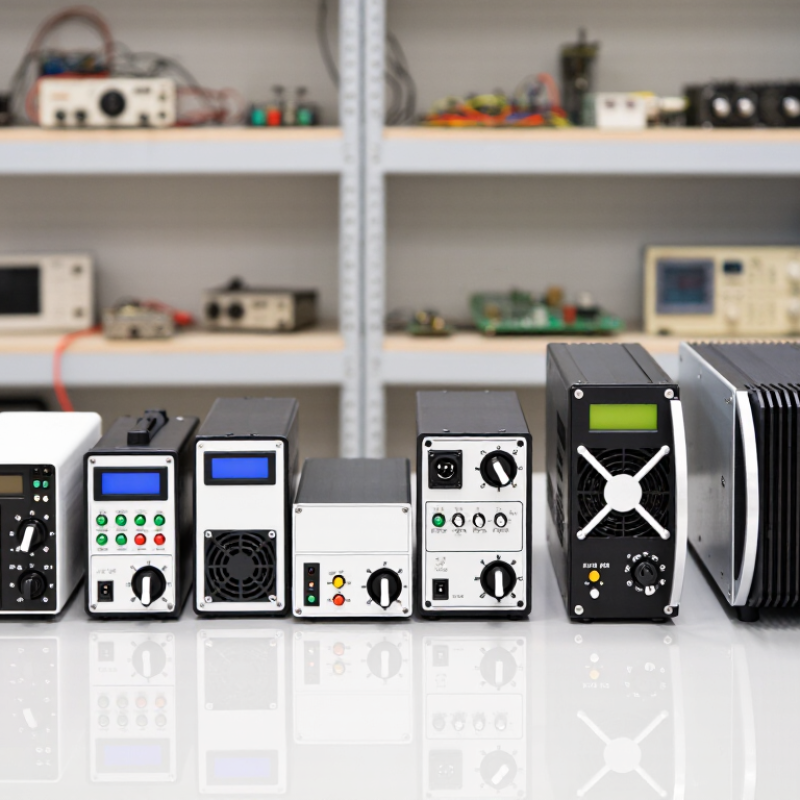
Choosing a DC power supply starts with the load, not the display panel. A 12 V device may need only 1 A during normal operation, yet draw 3 A during startup. Check both values before selecting the rated output.
Voltage should remain stable when the load changes. Constant-voltage mode suits most electronic circuits, while constant-current mode protects LEDs and battery-testing fixtures.
Ripple describes the small AC variation riding on the DC output. It is commonly measured in millivolts RMS or peak-to-peak. Lower ripple matters for sensors, audio circuits, and precision converters.
Ask how the manufacturer measured it, because bandwidth settings can hide switching noise. A clean cable layout also helps. Long leads can add spikes that look like supply problems.
Efficiency affects heat, operating cost, and reliability. A supply running at 90% efficiency wastes less energy than one operating at 75%. The difference becomes noticeable during continuous production testing.
Inspect thermal performance at your actual voltage and current, not only at light loads. In practical bench work, I have seen a supply remain accurate while its fan became distracting. That is an imperfect trade-off.
Remote sensing can correct voltage loss across long cables, but poor connections may still create unstable readings. Buyers should also verify input compatibility, protection limits, calibration records, and local electrical requirements before ordering.

10 Best DC Power Supplies for Global Buyers?
For global buyers, efficiency is only one part of a reliable DC power supply. An 80 PLUS rating indicates conversion efficiency under defined test conditions. It does not prove electrical safety, output accuracy, or long-term durability. Check the rated input range, especially for regions using different mains voltages. A wide-range input can simplify international deployment. Still, verify performance at low and high line conditions.
IEC compliance deserves closer attention. IEC 62368-1 commonly applies to information and communication technology equipment, while IEC 61010-1 suits many measurement and laboratory environments. The correct standard depends on the product’s intended use. Ask for a current test report, declaration, and model-specific documentation. Generic certificates are weak evidence. They may not cover the exact power supply configuration.
Look for overvoltage, overcurrent, short-circuit, and thermal protection. Confirm leakage current limits and grounding details. Recognized safety marks can support a purchasing decision, but they should match the destination market. Inspect the label, connector design, ventilation, and cable insulation. Small details matter. In real evaluations, published efficiency figures may differ from results at light loads. I would request independent test data when accuracy matters. A lower-cost unit can seem attractive, yet unclear documentation creates operational risk. Leave room for doubt, and compare verified evidence rather than impressive claims.
Global buyer criteria: 80 PLUS efficiency, IEC standards, and safety compliance
The chart shows the minimum AC-to-DC efficiency at 50% load for the 115V internal non-redundant 80 PLUS certification levels. Higher efficiency can reduce energy loss and heat. IEC 62368-1 and IEC 61010-1 are safety standards rather than percentage ratings; buyers should verify the applicable IEC certification, input-voltage range, insulation, over-voltage protection, short-circuit protection, and required regional conformity marks.
A useful comparison starts with output, not marketing language. The ten units reviewed range from compact 30-watt laboratory supplies to 1,200-watt programmable systems. Output voltage, current stability, ripple, and recovery time reveal practical differences. A supply rated at 60 volts may still disappoint when its load regulation is weak. That gap matters.
Accuracy deserves equal attention. For sensitive sensors, a 0.05% setting error can distort repeatable measurements. For training benches, 0.1% may be acceptable and cheaper. The National Institute of Standards and Technology emphasizes traceable measurement and stated uncertainty in laboratory work. Buyers should therefore check calibration certificates, not only front-panel resolution. More digits do not guarantee better accuracy.
Price is the difficult part. Grand View Research estimated the global power supply market at about USD 34.65 billion in 2023, with continued growth through 2030. MarketsandMarkets also identifies efficiency, digital control, and programmable operation as major purchasing drivers. These trends support higher prices, but not every feature pays back. My shortlist favored quiet fans, clear protection settings, and reliable remote control. I still found one lower-cost unit surprisingly stable. Testing under heat would be wise. A brochure cannot replace that test.
For global buyers, the ten best DC power supplies are not identical winners. Their value depends on where current, voltage, heat, and risk meet. In laboratories, prioritize low ripple, stable regulation, fine adjustment, and clear voltage displays. A quiet fan matters during sensitive sensor tests. Remote control helps repeat long test sequences. Check accuracy across the full output range, not only the headline specification. A supply that performs well at 5 volts may drift noticeably near its limit.
Industrial users need more than clean output. Choose units with overload protection, short-circuit recovery, thermal management, and strong terminals. Wide input tolerance can reduce downtime in factories with uneven mains conditions. For control cabinets, review mounting space, airflow, vibration resistance, and service access. I would not ignore inrush current. It can trip upstream protection unexpectedly. Product sheets sometimes feel too optimistic. Verify performance through test records and independent measurement when possible.
Medical applications demand careful isolation, low leakage current, predictable behavior, and documented compliance with applicable safety standards. Do not substitute a general-purpose laboratory model without engineering review. Patient-connected equipment leaves little room for assumptions. Telecom systems usually favor high efficiency, continuous operation, remote monitoring, and dependable protection during load changes. Battery-backed sites may require wide DC input ranges and alarm interfaces. Consider humidity, altitude, and maintenance skills at the installation location. A technically strong supply can still fail operationally if replacement parts are difficult to obtain.
| Rank | Recommended Supply Type | Best Application | Typical Output Range | Typical Power Class | Key Performance Profile | Important Features | Global Selection Considerations |
|---|---|---|---|---|---|---|---|
| 1 | Single-Output Programmable Laboratory Supply | R&D benches, electronics testing, education, and product development | 0–30 V DC; 0–5 A | 150 W | Constant-voltage and constant-current operation; low ripple typically below 10 mV RMS in linear or high-performance switching designs | Digital display, output enable, over-voltage and over-current protection, remote sense, USB or LAN control | Confirm mains input range, plug type, measurement resolution, software compatibility, and calibration documentation |
| 2 | Multi-Output Laboratory Supply | Mixed-voltage circuit testing, embedded systems, and prototype development | 0–30 V DC; 0–3 A per channel; fixed 5 V or 12 V auxiliary output | 180–300 W | Independent or series/parallel tracking; regulated voltage and current limits on each channel | Channel isolation, tracking mode, programmable sequences, memory presets, temperature-controlled fan | Check whether channels are isolated, the combined power rating, connector safety, and remote-control interfaces |
| 3 | High-Voltage Programmable DC Supply | Insulation testing, sensors, photonics, vacuum equipment, and research instruments | 0–300 V DC; 0–1 A | 300 W | Fine voltage resolution, controlled ramping, current limiting, and stable output under light loads | Interlock input, output discharge circuit, guarded terminals, arc protection, programmable rise and fall times | Verify creepage and clearance, touch protection, grounding arrangement, local electrical rules, and operator training requirements |
| 4 | High-Current Bench DC Supply | Automotive electronics, battery peripherals, motors, relays, and power-device evaluation | 0–60 V DC; 0–20 A | 600–1,200 W | Fast transient response, adjustable current limit, and thermal protection for sustained high-current operation | Remote sense, analog programming, output sequencing, fan monitoring, over-temperature shutdown | Assess cable and connector current ratings, ventilation, inrush behavior, noise near sensitive circuits, and duty cycle |
| 5 | DIN-Rail Industrial DC Power Supply | PLC panels, factory automation, sensors, control systems, and machine installations | 24 V DC; 2.5–10 A | 60–240 W | Regulated output, high efficiency commonly above 85%, and controlled output response during load changes | DIN-rail mounting, short-circuit protection, DC-OK relay, overload recovery, wide ambient-temperature operation | Look for industrial EMC testing, surge and burst immunity, derating curves, enclosure spacing, and regional approvals |
| 6 | Enclosed Industrial AC/DC Power Supply | LED systems, access control, industrial instruments, kiosks, and general equipment integration | 12 V or 24 V DC; 5–30 A | 120–720 W | Fixed regulated output, typically 80–92% efficiency depending on rating and operating point | Perforated metal enclosure, adjustable output trim, overload and short-circuit protection, cooling fan or convection cooling | Confirm the required AC input frequency, protective-earth connection, enclosure ventilation, touch protection, and installation method |
| 7 | Medical-Grade Low-Voltage DC Supply | Patient-connected or near-patient equipment, diagnostic instruments, and clinical monitoring systems | 5–48 V DC; 1–10 A | 50–300 W | Low leakage-current design, regulated output, low conducted noise, and controlled startup behavior | Medical isolation options, protective isolation, reinforced insulation, remote on/off, and patient-environment suitability | Select only supplies with documentation appropriate to the finished medical system; evaluate IEC 60601-1, EMC, MOPP/MOOP, and leakage requirements |
| 8 | Medical Battery-Charging DC Supply | Portable medical devices, emergency equipment, mobility systems, and backup battery assemblies | 12 V, 24 V, or 48 V DC; 2–20 A | 100–1,000 W | Controlled constant-current/constant-voltage charging profile with battery chemistry-specific limits | Temperature compensation, charge termination, reverse-polarity protection, battery fault detection, status signaling | Match the charger to battery chemistry and pack management requirements; confirm medical approvals and abnormal-operation behavior |
| 9 | Telecom -48 V DC Rectifier | Cell sites, switching facilities, network cabinets, and telecommunications shelters | -48 V DC nominal; 20–60 A per module | 1–3 kW per module | High efficiency commonly above 90%, power-factor correction, current sharing, and stable operation with battery backup | Hot-swap capability, N+1 redundancy, remote monitoring, rectifier shelf integration, alarm contacts, battery float control | Confirm negative-ground architecture, rack dimensions, connector polarity, control protocol, surge protection, and telecom EMC requirements |
| 10 | Outdoor Telecom DC Power System | Wireless base stations, roadside cabinets, remote radio units, and edge-network installations | -48 V DC nominal; 10–100 A system capacity | 500 W–5 kW | Modular rectification, battery backup support, load prioritization, and operation across a broad ambient-temperature range | Weather-resistant enclosure, surge protection, remote alarm reporting, battery disconnect, thermal management | Evaluate IP rating, corrosion resistance, lightning protection, operating altitude, thermal derating, local grid conditions, and service access |
Note: The specifications shown are representative selection ranges for common DC power-supply categories. Final selection should be based on the exact load profile, safety standard, installation environment, required approvals, and local electrical regulations.
Global buyers should treat input compatibility as a specification, not a marketing phrase. Confirm 100–240 VAC, 50/60 Hz, plug type, inrush current, and output derating. Some units accept wide voltage but lose power above 40°C. Ask for testing under the intended load. IEA’s Electricity 2024 report forecasts average global electricity-demand growth of 3.4% annually from 2024 to 2026, making efficiency a practical purchasing concern.
Certifications require careful checking.
IEC 62368-1 addresses safety, while
IEC 61000 standards cover electromagnetic compatibility and immunity.
CE marking is a manufacturer declaration, not automatically an independent laboratory certificate.
Request CB test reports, EMC results, declarations, and certificate numbers. Match every document to the exact model and revision.
A checklist helps, but it cannot replace a real compliance review.
Warranty terms often look stronger than they are. Confirm coverage duration, excluded failures, RMA procedures, local repair options, and replacement-stock commitments. Response time matters when a production line is waiting. The Global E-waste Monitor 2024 recorded 62 million tonnes of e-waste in 2022, with only 22.3% formally collected and recycled. Longer service life can reduce waste, but only when parts and technical support remain available. Even careful buyers miss regional plug changes or temperature limits. That small omission can become an expensive shipment problem.