- Home
-
 Products
- Application
- About Us
-
 News
- Video
- Blog
- Contact Us
Leave Your Message
-
 Whatsapp
-
 Skype
-
 Wechat
Products
News
Whatsapp
Skype
Wechat
Global sourcing demands power equipment that performs reliably across different markets, climates, and electrical systems. A Switching Power Supply can support this need through high efficiency, compact design, and flexible input ranges. These features help reduce energy waste, shipping volume, and installation challenges. They also matter when equipment operates in a warm warehouse or a remote service center.
However, selecting the right model involves more than comparing prices. Experienced sourcing teams review efficiency ratings, output stability, protection functions, thermal performance, and expected service life. They also verify safety certifications and regional compliance before approving a supplier. A dependable manufacturer should provide test reports, traceable materials, clear datasheets, and consistent production controls. Small details matter. A poorly documented connector or unclear voltage tolerance can create costly delays.
Supplier audits and sample testing offer practical evidence beyond marketing claims. Engineers may test units under full load, repeated startup cycles, and unstable input conditions. Field feedback can reveal problems that laboratory testing misses. Still, no product is perfect. A model that performs well in one region may require adjustment elsewhere. Assumptions can fail. Buyers should confirm local requirements, replacement availability, warranty terms, and technical support before placing larger orders. This article explores why choosing a Switching Power Supply can strengthen global procurement decisions while recognizing the risks that careful buyers must manage.
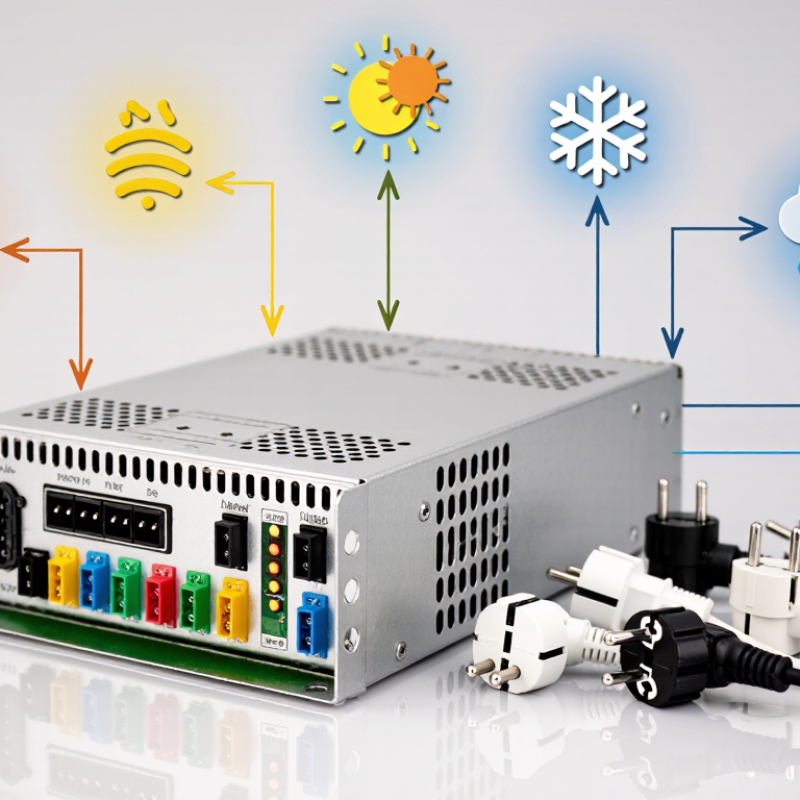
A switching power supply converts electrical energy by rapidly turning current on and off. This process uses electronic switches, transformers, inductors, capacitors, and control circuits. The switching frequency is usually much higher than household power frequency. That allows the transformer and other magnetic parts to remain compact.
The control circuit constantly checks the output voltage. If the load changes, it adjusts the switching pattern within a very short time. For example, a supply powering a sensor may respond when the sensor activates or enters standby mode. This design can achieve high efficiency with less heat than many traditional linear supplies. It can also support different input ranges, which matters when equipment is sourced for several countries.
Not perfectly simple.
Engineers must still examine ripple, electromagnetic interference, insulation, grounding, and protection against overload or short circuits. A unit that works well in a quiet laboratory may behave differently beside motors or wireless equipment. I have found that datasheet efficiency alone can mislead; cooling, cable length, and real load conditions also affect performance. Safety testing should match the target market and installation environment. During supplier evaluation, request test reports, production samples, traceable component information, and clear input and output specifications. Small details matter, especially the stated voltage tolerance and operating temperature range.
| Evaluation Dimension | Typical Switching Power Supply Data | Global Sourcing Relevance |
|---|---|---|
| Definition | An electronic power converter that rapidly switches semiconductor devices to regulate and transfer electrical energy through a transformer, inductor, or capacitive circuit. | The same basic technology can be adapted to different input voltages, output ratings, form factors, and end-use requirements. |
| Common Input Voltage Range | Universal AC input models commonly support approximately 90–264 V AC at 47–63 Hz. DC-input models may use a specified DC range. | A universal-input design can support major 100–120 V and 220–240 V markets with fewer product variants. |
| Typical Output Power | Commercial products range from less than 5 W for compact electronics to several kilowatts for industrial equipment; the exact rating depends on the design and cooling method. | Suppliers can usually offer scalable platforms for consumer, telecom, lighting, automation, and industrial applications. |
| Typical Efficiency | Approximately 75–95% for many modern designs, depending on power level, topology, load, input voltage, and thermal conditions. | Higher efficiency reduces energy loss, operating temperature, and shipping or installation requirements for thermal management. |
| Power Density | Generally higher than a linear power supply because high-frequency switching allows smaller transformers, inductors, and heat sinks. | Smaller and lighter units can lower enclosure size, product weight, freight volume, and installation space. |
| Operating Frequency | The switching frequency is commonly in the tens to hundreds of kilohertz, although some designs operate at higher frequencies. | Frequency selection affects size, electromagnetic interference, efficiency, component selection, and compliance testing. |
| Output Voltage Options | Common regulated outputs include 5 V, 9 V, 12 V, 15 V, 24 V, and 48 V DC, with custom values also possible. | Multiple output configurations allow one sourcing program to serve different equipment platforms and regional product versions. |
| Voltage Regulation | Many regulated models maintain output voltage within approximately ±1–5% under defined line, load, and temperature conditions. | Stable output helps protect sensitive electronics and supports consistent performance across different electrical grids. |
| Protection Functions | Common protections include short-circuit, over-current, over-voltage, over-temperature, and input surge protection. | Built-in protection can reduce field failures caused by unstable grids, incorrect wiring, overloads, or abnormal operating conditions. |
| Power Factor Consideration | Basic models may have a lower power factor, while active power-factor-correction designs can achieve approximately 0.90–0.99 under specified conditions. | Power-factor requirements may affect product selection, especially for higher-power equipment and commercial installations. |
| Electromagnetic Compatibility | Switching circuits generate high-frequency noise, so filtering, shielding, grounding, and PCB layout are important design factors. | EMC performance must be verified against the requirements of the destination market and the final equipment. |
| Safety Requirements | Design evaluation typically considers insulation, creepage and clearance, dielectric strength, leakage current, temperature rise, and fire enclosure requirements. | The required safety standard depends on product category, installation environment, voltage class, and destination region. |
| Thermal Management | Cooling may use natural convection, forced-air fans, conductive cooling, or a combination of methods. | The cooling method influences noise level, enclosure design, maintenance needs, and suitability for hot or dusty environments. |
| No-Load Power Consumption | Energy-saving designs can reduce standby consumption to below 0.5 W or below 1 W, depending on the applicable requirement and product class. | Low standby consumption supports energy regulations and helps reduce lifetime electricity costs in continuously connected equipment. |
| Key Procurement Checks | Confirm input range, output tolerance, rated power, peak load, ripple and noise, operating temperature, protection functions, connector type, and mechanical dimensions. | A complete specification reduces compatibility risks and makes quotations from different suppliers easier to compare. |
Note: Performance values are typical engineering ranges. Actual specifications depend on the power supply design, rated load, test conditions, product category, and applicable regional requirements.