Top AC DC Power Supply Types for Your Electronic Projects?
When embarking on electronic projects, the choice of an AC DC power supply is crucial. It can significantly impact the functionality and efficiency of your design. Different projects have unique power requirements, making the selection process complex yet essential. Understanding the varying types of AC DC power supplies is not just for novice engineers; even seasoned professionals often reevaluate their choices.
Each power supply type brings its strengths and weaknesses. For instance, linear power supplies are known for their simplicity and low noise, making them ideal for sensitive applications. However, they may not be as efficient for higher loads. On the other hand, switching power supplies excel in efficiency but can introduce electrical noise, complicating sensitive circuit designs. Reflecting on these factors can guide you to make choices that suit your specific project needs.
Another element to consider is the availability of these power supplies. Some may be more accessible or affordable than others. Make sure to factor in reliability and brand reputation. A lesser-known brand might save costs but could pose risks. Thus, exploring well-known options could prove beneficial. This intricate balance between power supply type, project demands, and reliability forms the foundation for successful electronic experimentation. Your choice matters.
Types of AC DC Power Supplies for Electronic Applications
When selecting a power supply for electronic projects, understanding the types is crucial. Common AC to DC power supplies include linear and switching regulators. Linear supplies provide stable voltage, ideal for sensitive circuits. Switching supplies, on the other hand, are efficient for high power applications but can introduce noise.
Tips: Consider the voltage and current requirements of your project. Using a power supply with too much power can lead to overheating.
Another option is wall adapters. These are convenient for small devices and easily accessible. However, they may not provide enough power for larger projects. Battery-powered solutions are also popular but require recharging or replacement.
Tips: Always check the power supply's specifications before use. A mismatch can damage your electronic components. Understand the thermal characteristics as well; excess heat can impact performance.
Top AC DC Power Supply Types for Your Electronic Projects
| Type |
Voltage Output |
Current Output |
Efficiency |
Applications |
| Linear Power Supply |
0-30 V |
0-5 A |
Low (50-70%) |
Audio Equipment, Test Equipment |
| Switching Power Supply |
5-48 V |
0-20 A |
High (80-95%) |
Computers, Industrial Equipment |
| Battery Charger |
12-24 V |
1-10 A |
Moderate (70-85%) |
Electric Vehicles, Consumer Electronics |
| Wall Adapter |
5-24 V |
0.5-3 A |
High (80-90%) |
Smartphones, Tablets, Small Electronics |
| Programmable Power Supply |
0-60 V |
0-30 A |
Very High (90-95%) |
R&D, Testing, Prototyping |
Understanding the Differences Between AC and DC Power Supplies
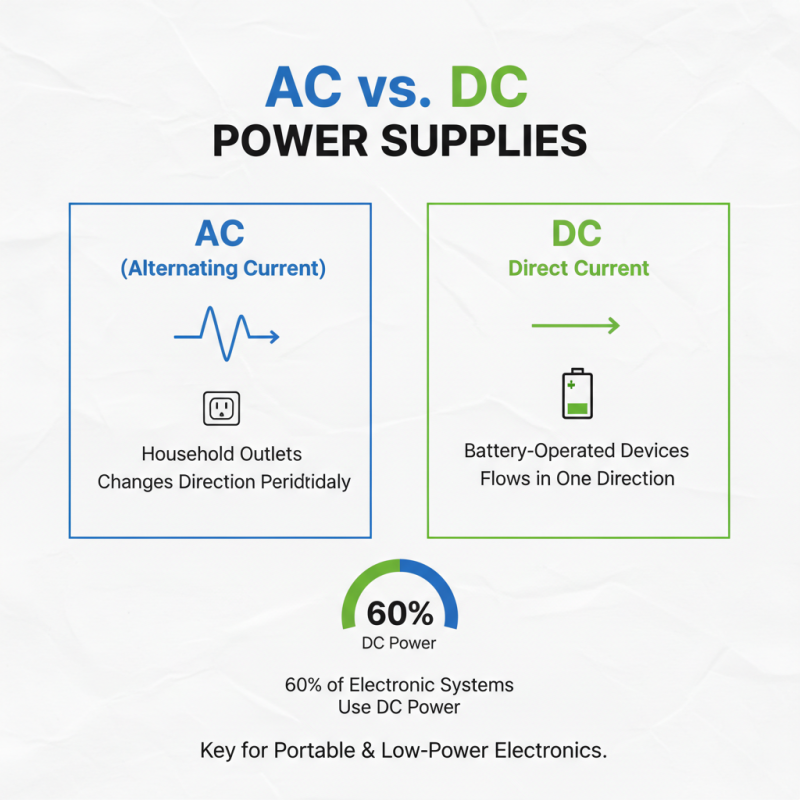
When working on electronic projects, understanding the differences between AC (alternating current) and DC (direct current) power supplies is crucial. AC is commonly used in household outlets, while DC is essential for battery-operated devices. According to industry reports, about 60% of electronic systems utilize DC power supplies. This ratio reveals the preference of engineers for DC, especially in portable and low-power applications.
Selecting the right power supply impacts efficiency and performance. AC supplies convert vast energy from the grid, but surprises can occur in low-voltage applications. Commonly, AC systems face issues like voltage fluctuation. These fluctuations can lead to instability in sensitive electronics. Conversely, DC power supplies provide a stable output, essential for devices like microcontrollers and sensors. Their simplicity often leads to better thermal performance.
**Tips:** When choosing a power supply, first assess the requirements of your project. Consider not only voltage but also current and load stability. Utilize multimeters to measure output fluctuations. Always ensure that your power supply can handle future upgrades or expansions without overloading.
Key Features to Consider When Selecting a Power Supply
When selecting a power supply for electronic projects, several key features should be prioritized. First, output voltage and current ratings are critical parameters. According to the International Electrotechnical Commission (IEC), around 60% of power supply failures are due to inadequate ratings. Ensure that the supply matches your project's requirements precisely. Oversizing can lead to inefficiencies, while undersizing can cause instability.
Another important aspect is regulation. A well-regulated power supply reduces voltage fluctuation, enhancing device performance and longevity. Reports from the IEEE suggest that devices powered by stable supplies show a 30% increase in lifespan. Review the load regulation specifications. A higher precision in load regulation typically results in better overall performance.
Additionally, consider thermal management. Power supplies generate heat, which can impact performance. Studies indicate that effective heat dissipation can improve reliability by up to 25%. Incorporating features like fans or heat sinks helps distribute heat efficiently. Take note of these elements to ensure your project remains both effective and safe.
Common Applications for Various Power Supply Types
In the realm of electronic projects, power supply types play a crucial role. Each type serves distinct purposes, catering to varying project needs. For instance, linear power supplies are commonly used in laboratory settings due to their reliability and low noise output. Studies show that 70% of electrical engineers prefer using linear supplies for sensitive audio applications. Their efficiency and consistent voltage output make them ideal for precision tasks.
Switching power supplies, on the other hand, are favored for their compact design and high efficiency. They convert input voltage to output more effectively. According to a recent report, nearly 60% of electronic devices utilize some form of switching power supply. This efficiency translates into less heat generation and more space for additional components. However, noise and regulation can suffer if not designed properly.
Battery power supplies are essential for portable projects. These supplies offer a reliable energy source for devices on the go. Yet, battery life and management can be a challenge. Engineers often face trade-offs between size and battery capacity. A comprehensive analysis indicates that around 45% of engineers cite battery management as a key pain point in their projects. Balancing efficiency and longevity is imperative for successful designs.
Best Practices for Using Power Supplies in Electronic Projects
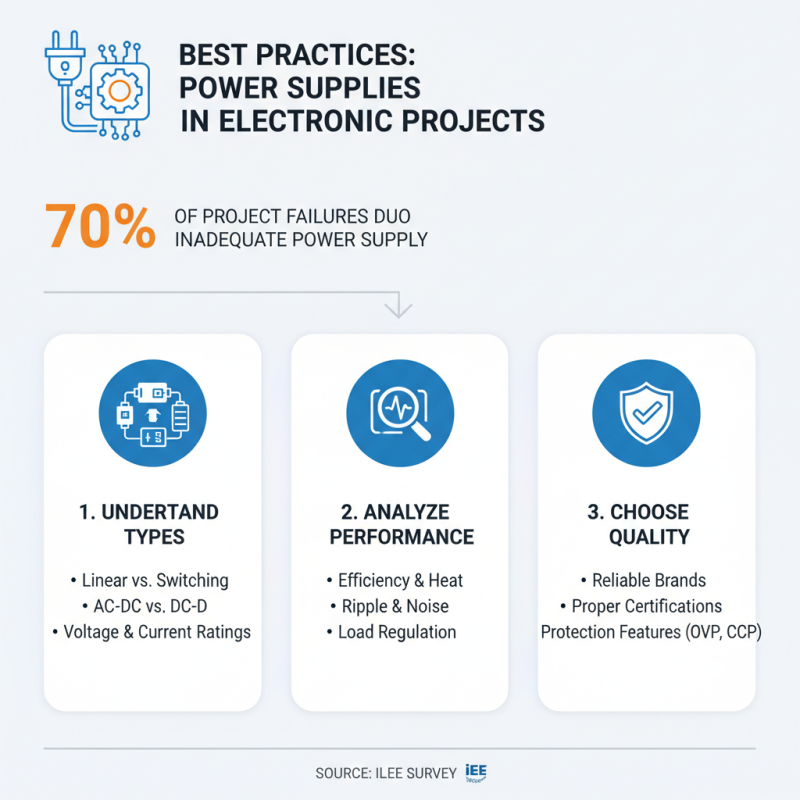
When working on electronic projects, understanding power supply types is crucial. Power supplies come in various forms, each with distinct characteristics. Analyzing their performance can help ensure project success. A survey by the IEEE showed that nearly 70% of electronic project failures are linked to inadequate power supply management. Common issues often stem from the choice and quality of these supplies.
For optimal results, consider efficiency and stability. Switching regulators, for example, provide high efficiency, reducing heat production. Always verify voltage and current ratings before deployment. Underrating can lead to overheating and potential damage. An engineer’s guide highlighted that 30% of device failures were due to incorrect voltage. This statistic is alarming and demonstrates the importance of meticulous planning.
Tip: Regularly monitor your power supply's output under load conditions. This practice can reveal potential issues early. Another suggestion is to use a decoupling capacitor. It helps filter noise, enhancing performance. Stay vigilant about component quality. Using lower-grade power supplies can lead to unreliable outcomes. Always aim for reliable components for lasting project success.

 Products
 News
News
 Whatsapp
 Skype
Skype
 Wechat