Top AC DC Power Supply Options for Your Electronics Needs?
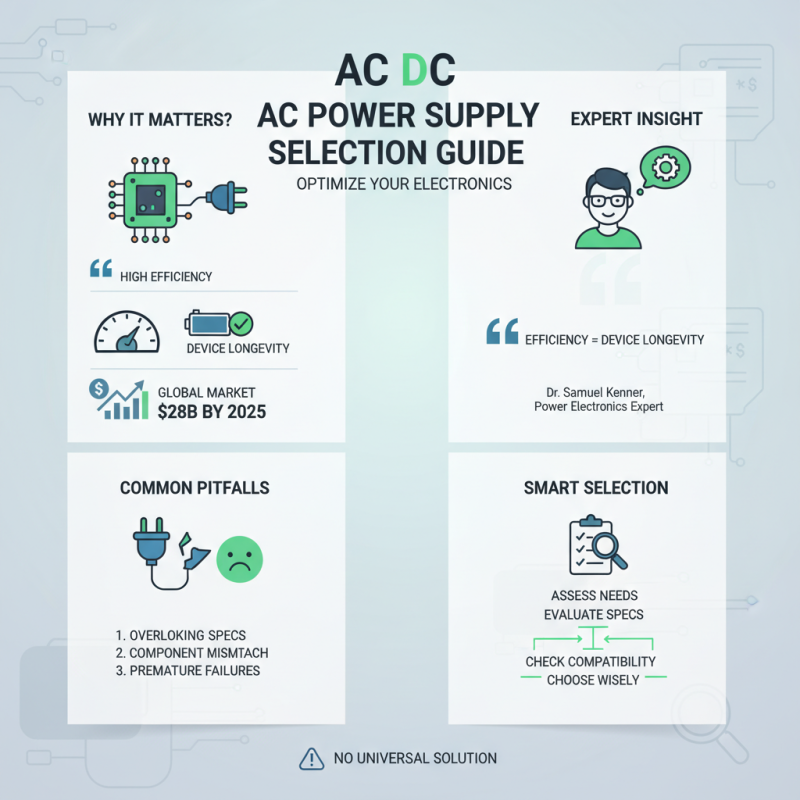
In today's electronic landscape, selecting the right AC DC power supply is crucial. The efficiency and reliability of these power supplies can significantly impact device performance. According to a recent Market Research Report, the global AC DC power supply market is projected to reach $28 billion by 2025. This growth underscores a growing dependence on stable and efficient power solutions across various industries.
Expert Dr. Samuel Kenner, a leading authority on power electronics, emphasizes, "The choice of AC DC power supply determines not just efficiency, but also the longevity of your devices." Yet, many consumers often overlook critical factors when choosing their power supplies, leading to mismatches and potential device failures.
Choosing the best option requires a nuanced understanding of specifications and applications. While various models exist, not all meet the required standards for particular uses. This complexity can overwhelm users. It's essential to carefully evaluate each option and recognize that the perfect power supply may not exist for every situation.
Understanding the Basics of AC and DC Power Supply
When it comes to powering your electronics, understanding the difference between AC and DC is essential. AC, or alternating current, is the type of electricity provided by power outlets. It changes direction periodically. This can make it suitable for home appliances and large devices. DC, or direct current, flows in a single direction. It is commonly used in batteries and portable gadgets.
Many electronic devices require specific types of power. A misstep in choosing the right supply can lead to device failure. Some devices may not operate properly without the correct power. For example, a toy powered by AA batteries will not function well with an AC outlet.
Choosing between AC and DC power supplies requires careful thought. Consider the device's specifications before making a decision. An overpowered device may suffer damage. Underpowered devices may not work at all. Being informed can help ensure that electronics perform at their best.
Key Factors to Consider When Choosing Power Supplies
When selecting an AC DC power supply, several crucial factors emerge. Voltage and current ratings stand out prominently. A mismatch here can lead to device failure. Most electronics require specific voltage levels. Reports indicate that 80% of power supply failures stem from incorrect voltage delivery. Therefore, understanding these specifications is vital for performance and reliability.
Another important aspect is efficiency. Modern power supplies often have an efficiency rating above 90%. This means they waste less energy as heat. High efficiency translates to lower operational costs. However, it’s also essential to consider thermal management. Poor heat dissipation can shorten a power supply's lifespan. Some reports warn that up to 25% of power supplies fail due to inadequate cooling systems.
Form factor plays a role as well. Not all power supplies fit in every space. Manufacturers often overlook the physical dimensions. This oversight can lead to compatibility issues. Additionally, some users fail to account for noise levels. High-frequency noise can interfere with sensitive electronics. Ensuring the power supply meets your specific requirements is paramount.
Top AC/DC Power Supply Options for Your Electronics Needs
This chart represents the efficiency ratings of various types of power supplies based on their output power in watts. The data demonstrates the importance of selecting the right power supply for different electronic applications.
Top AC Power Supply Models Available on the Market
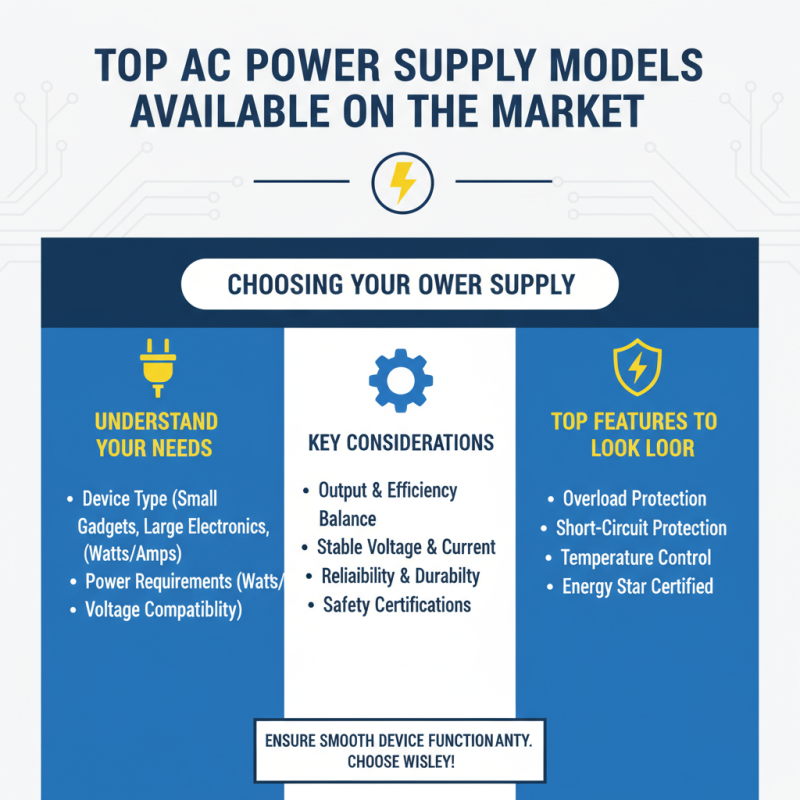
When choosing an AC power supply, understanding your needs is crucial. Many options cater to various devices, from small gadgets to larger electronics. A reliable power supply balances output and efficiency, ensuring that your devices function smoothly. Look for units that provide stable voltage and current. This stability is essential for sensitive equipment.
Consider factors such as wattage and form factor. Smaller models may save space but often have limited power output. However, larger supplies can be bulkier and may consume more energy. It's a common mistake to overlook these details. Many users find themselves with insufficient power, leading to disappointing performance.
Pay attention to the features offered. Protection circuits are vital for safeguarding your equipment. Some models include short-circuit and overload protection, which can save you from costly repairs. Many users tend to undervalue these features, only realizing their importance after an incident occurs. Measuring initial demand against future expansion is key to finding the right power supply for long-term use.
Top DC Power Supply Models Available on the Market
Finding the right DC power supply for your electronics needs can be challenging. The market offers a diverse range of options, making it tough to choose. You'll encounter models with various output voltages and currents, each designed for specific applications.
For hobbyists, a benchtop DC power supply might be ideal. These units often come with adjustable settings. They allow for precise control over voltage and current. Another option is a compact, switch-mode power supply, which is lightweight and efficient. However, not all models perform reliably under load. Sometimes, they can introduce noise in sensitive projects.
You might also find linear power supplies appealing. They provide stable output and low noise. Nonetheless, they tend to be larger and less efficient. It's crucial to weigh pros and cons before making a decision. Engage in user reviews to catch hidden issues and real-world performance insights.
Best Practices for Maintaining Your Power Supply Units
When maintaining your power supply units, attention to detail is crucial. Regular checks are essential. Dust can accumulate and block ventilation. This leads to overheating. Ensure you use compressed air to clean your power supply every few months. Tight connections are also vital. Loose wires can cause fluctuations and damage.
Tip: Use a surge protector to safeguard your supply from voltage spikes. Power surges can destroy sensitive electronics. Investing in a good surge protector is wise. It's a small cost for significant protection.
Over time, components may degrade. It’s important to check capacitors for bulging or leakage. Faulty capacitors risk total failure. Consider replacing them if you notice any issues. Additionally, monitor temperature levels. Excessive heat indicates trouble. If your power supply feels hot to touch, it may need replacement.
Tip: Keep your workspace organized. A clutter-free area minimizes risks of accidental damage during repairs. Always unplug devices before servicing. Small mistakes can lead to big problems. Trust your instincts and don’t overlook the details. Regular maintenance extends the life of your power supply.
Top AC DC Power Supply Options for Your Electronics Needs
| Power Supply Type |
Output Voltage |
Output Current |
Efficiency |
Features |
| Linear |
5V |
5A |
80% |
Low noise, simple design |
| Switching |
12V |
10A |
90% |
Compact size, adjustable output |
| Programmable |
24V |
3A |
85% |
Remote control, programmable settings |
| Desktop |
19V |
4.5A |
88% |
Stable output, user-friendly |
| AC-DC Adapter |
5V |
2A |
82% |
Lightweight, portable |

 Products
 News
News
 Whatsapp
 Skype
Skype
 Wechat