2026 How to Choose the Right Switching Power Supply for Your Needs?
Choosing the right Switching Power Supply is crucial for many applications. This decision impacts efficiency, performance, and overall system reliability. With various options available, understanding your specific needs becomes essential.
Power supplies differ in voltage, current, and design. Selecting one that meets your requirements can be challenging. You must consider the voltage range, power rating, and load characteristics. A mismatch could lead to inefficient operation and potential failure.
Experience plays a significant role in making the right choice. Consulting experts and analyzing specifications will help you gain confidence in your decision. Some options may seem appealing but could be unreliable in the long run. Avoid falling into the trap of choosing based solely on price. Reflect on your application and ensure the power supply will meet your expectations.
Understanding Switching Power Supply Basics
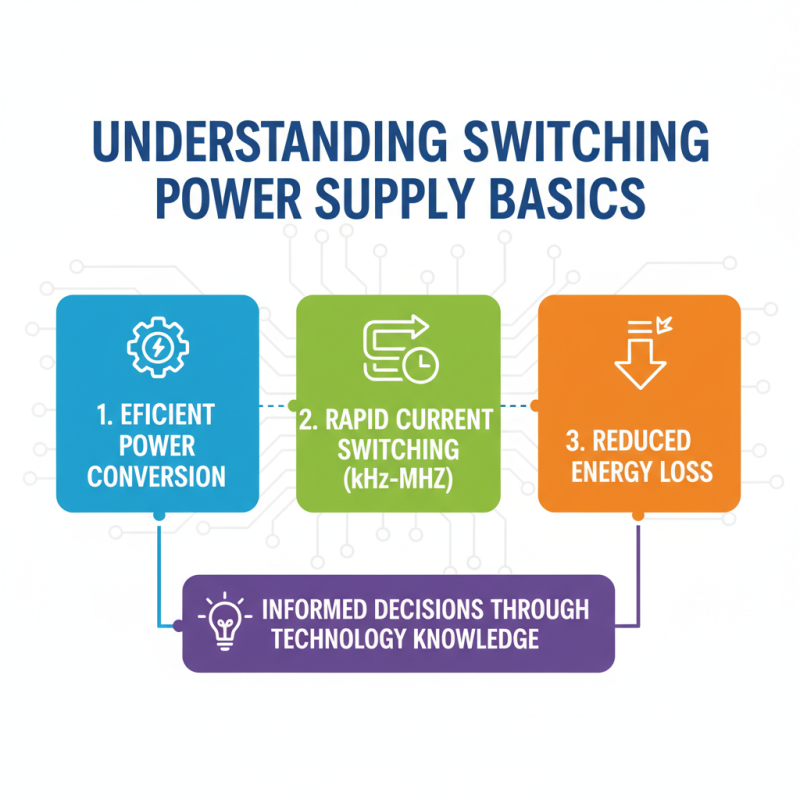
When selecting a switching power supply, understanding the basics is crucial. Switching power supplies convert electrical power efficiently. They switch routes for current flow many times per second. This process reduces energy loss. Knowing how this technology works provides a foundation for making informed decisions.
Consider the input voltage range. Different devices have varying requirements. A good power supply must match these requirements effectively. Additionally, pay attention to the output voltage and current specifications. They ensure the device gets the power it needs. It’s also important to consider efficiency ratings. Higher efficiency typically means less heat generation and lower energy bills.
Choosing the right power supply can be tricky. It’s easy to focus solely on price. However, cheaper options might lead to poor performance or safety risks. Sizing the supply correctly is another common issue. A supply that is too small can overheat. Conversely, one that is too large may be wasteful. Balancing these factors is essential for optimal performance.
Identifying Your Power Requirements and Specifications
Choosing the right switching power supply requires a deep understanding of your power needs. Start by calculating the total wattage your devices require. A recent industry report suggests that over 30% of design failures occur due to underestimated power needs. Therefore, be precise. Take into account peak loads and efficiency ratings. Many supplies operate best at specific loads; sudden surges can cause failures.
Tip: Always consider additional power for future expansions. A margin of 20-30% above your calculated needs can provide a buffer. This is essential in environments where load can fluctuate unexpectedly.
Next, examine the specifications. Look for voltage stability and regulation. Fluctuations can harm sensitive components. The same report showed that a steady power supply increases device longevity. Therefore, prioritize quality over cost. Some lower-priced options may not perform reliably, leading to potential equipment damage.
Tip: Review efficiency ratings on the power supply. Higher efficiency can save costs in the long run and reduce heat generation. Remember, a little extra research can lead to significant savings.
Power Supply Selection for Various Applications
Evaluating Efficiency and Performance Metrics
When choosing a switching power supply, efficiency and performance metrics stand out as key factors. According to industry reports, power supply efficiency often ranges from 80% to 95%. Higher efficiency reduces energy consumption, which is crucial in minimizing operational costs. This can save businesses significant amounts in the long run.
Performance metrics include ripple voltage and transient response. Ripple voltage should be as low as possible; ideally, under 50 mV for sensitive applications. Transient response indicates how quickly the power supply reacts to load changes. Specifications may vary, but a response time of less than 10 ms is generally expected. Evaluating these metrics ensures reliability, especially in high-stakes environments.
Many engineers overlook the importance of thermal performance. A cooler power supply tends to have a longer lifespan. However, heat management requires careful design consideration. Implementing effective cooling solutions can be complex, and sometimes even the best designs may fall short. Regularly revisiting these parameters can lead to better choices and improvements in system stability and longevity.
2026 How to Choose the Right Switching Power Supply for Your Needs? - Evaluating Efficiency and Performance Metrics
| Power Supply Rating (W) |
Efficiency (%) |
Input Voltage (V) |
Output Voltage (V) |
Load Regulation (%) |
Ripple Voltage (mV) |
| 100 |
85 |
100-240 |
12 |
±5 |
50 |
| 200 |
90 |
100-240 |
24 |
±3 |
40 |
| 300 |
92 |
100-240 |
48 |
±2 |
30 |
| 400 |
93 |
100-240 |
60 |
±1 |
25 |
| 500 |
94 |
100-240 |
75 |
±1 |
20 |
Considering Physical Size and Heat Dissipation Factors
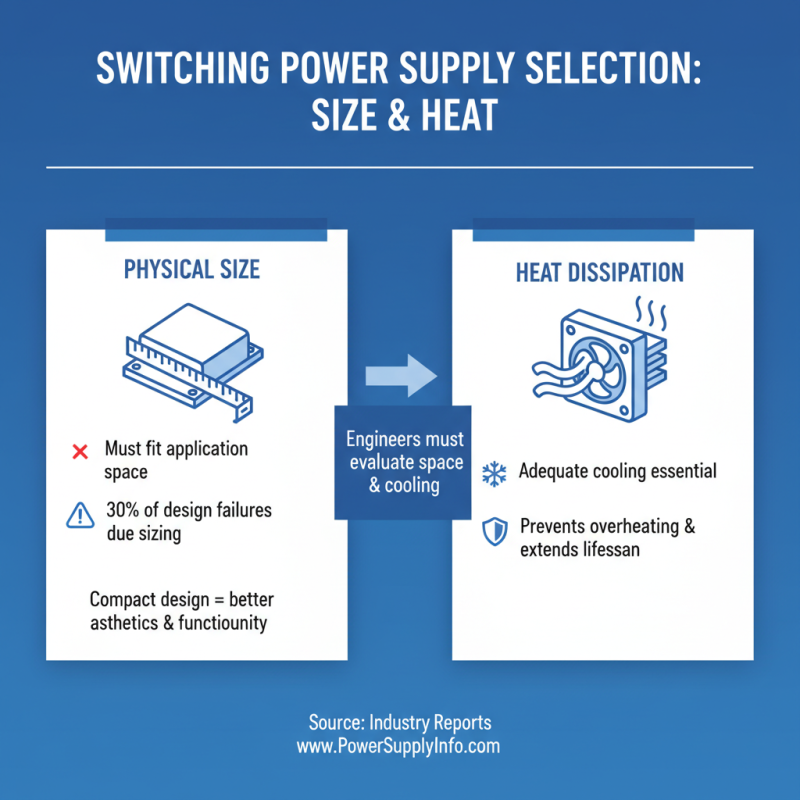
When selecting a switching power supply, understanding physical size and heat dissipation is crucial. A power supply that is too large may not fit your application. Industry reports indicate that 30% of design failures are due to sizing issues. Engineers must evaluate the available space carefully. A compact design can enhance product aesthetics and functionality.
Heat dissipation significantly impacts performance. Insufficient cooling can lead to overheating, which reduces the lifespan of the power supply. According to a 2022 study, 50% of power supply failures resulted from inadequate thermal management. Employing heat sinks or fans can help mitigate these issues. However, adding these components can increase the size and complexity of the design.
Consider also the ambient temperature and airflow. Areas with limited ventilation might require additional cooling solutions. Balancing size and heat dissipation is essential but often challenging. The need for more compact designs can conflict with adequate cooling. Reflection on these factors can lead to better-informed decisions and ultimately, more reliable power supply solutions.
Reviewing Safety Standards and Regulatory Compliance
When selecting a switching power supply, safety standards and regulatory compliance are crucial. Regulatory bodies like the IEC, UL, and EN set benchmarks that manufacturers must meet. For instance, the IEC 60950 standard outlines safety for information technology equipment. Compliance with these standards ensures that your power supply can handle voltage surges and thermal stresses.
A report by MarketsandMarkets reveals that the global demand for power supplies is projected to reach $37.1 billion by 2025. Safety features like overvoltage protection and short-circuit protection are not just extras; they are essential. Reports indicate that nearly 30% of power supply failures result from poor thermal management. Lack of adherence to safety standards can lead to equipment damage or even fires.
We must reflect on the cons of rushing through compliance checks. Shortening testing phases can result in fatal flaws. Choosing a power supply without thorough evaluation neglects safety, risking both personal and equipment safety. Evaluate all certifications before making a decision. The right choice protects you and enhances overall reliability.

 Products
 News
News
 Whatsapp
 Skype
Skype
 Wechat